
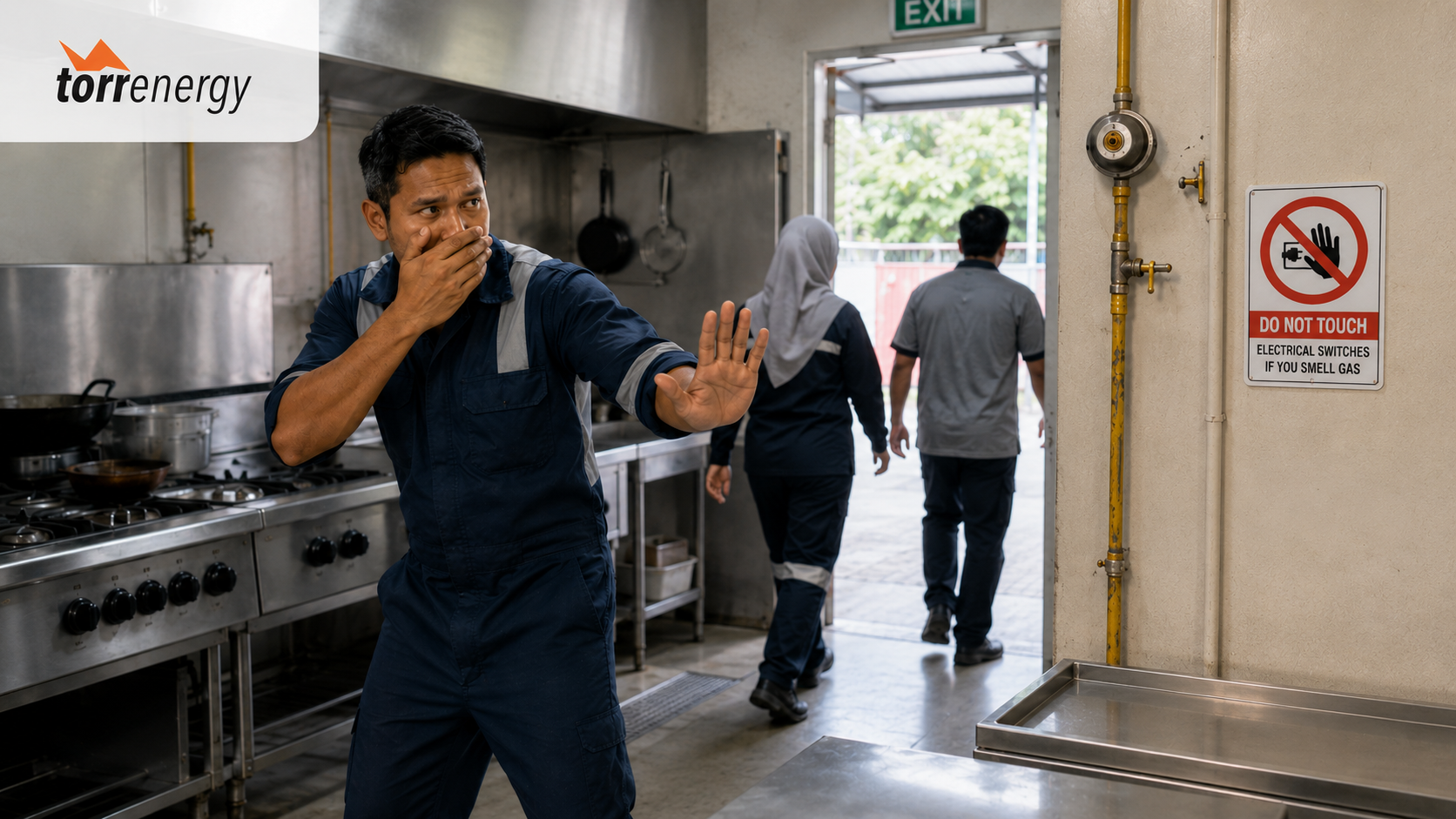
The smell of gas in a workplace is one of those moments where people often do exactly the wrong thing. This is not because they don’t care, but because nobody has ever told them clearly what the right thing is. Some people go looking for the source. Some open a window and wait to see if it goes away. Some assume someone else will deal with it. Some light a cigarette outside before evacuating.
This guide is for the non-specialist employee, specifically the person who smells something and needs to know what to do in the next 60 seconds. It is not a technical manual. It is the practical guidance that most workplaces assume someone has given their staff and that, in our experience, most workplaces have not.
First: understand what you might be smelling
In Malaysian workplaces, the most common gas hazards are LPG (liquefied petroleum gas) and natural gas, both of which are used for heating, cooking, and process applications. Both are naturally odourless, but an odorant, typically ethyl mercaptan, which smells like rotten eggs or a strong sulphur smell, is added by suppliers specifically so that leaks can be detected by smell.
LPG is heavier than air. If it leaks, it sinks to the floor and accumulates in low points such as floor drains, spaces under equipment, and stairwells. This matters because a pocket of LPG at low level is not always obvious by smell until you disturb it, and it can accumulate to explosive concentrations in enclosed low spaces without triggering the alarm in a ceiling-mounted gas detector.
Natural gas (piped gas) is lighter than air. It rises and disperses more quickly in a ventilated space, but accumulates at ceiling level in enclosed or poorly ventilated areas. If you smell a faint gas smell in an enclosed room with high ceilings, the concentration may be higher up near the ceiling than at breathing height.
Not every unusual smell is gas. Solvent vapours, cleaning products, certain chemical processes, and even some organic material decomposition can produce smells that some people associate with gas. If you are not certain what you are smelling, treat it as a gas leak until someone qualified has confirmed otherwise.
What to do in order
What not to do
The most dangerous response to a gas smell is the one that delays the evacuation by a few minutes to investigate, confirm, or deal with the source. A gas leak in an enclosed space can reach an explosive concentration faster than most people assume. The job of an ordinary employee in the first 60 seconds is not to find the leak. It is to get people out of the area while the atmosphere is still safe enough to do that calmly and without harm.
What happens next: the employer’s responsibility
Once the immediate emergency is managed, with the area cleared, source identified, gas supply shut off, and BOMBA or the gas utility notified, the employer is responsible for determining what caused the leak, having the gas system inspected and cleared by a qualified person before it is returned to use, and reviewing whether the workplace’s emergency procedures and staff awareness are adequate to prevent a similar event from being handled poorly in the future.
A gas leak that is detected early and handled correctly is a near-miss, meaning an incident that could have been much worse. The value of a near-miss is the opportunity to understand what allowed it to happen and to fix it before the next one is not caught so early. That review is the employer’s responsibility. The immediate response of getting people out safely is everyone’s responsibility.
Does Your Workplace Have a Gas Emergency Procedure?
Torr Energy supports workplaces with gas safety assessments, gas detection system design, and emergency response planning. If your team is not clear on what to do when they smell gas, contact us to discuss training and system options.
Talk to Torr Energy →


Leave a Reply