
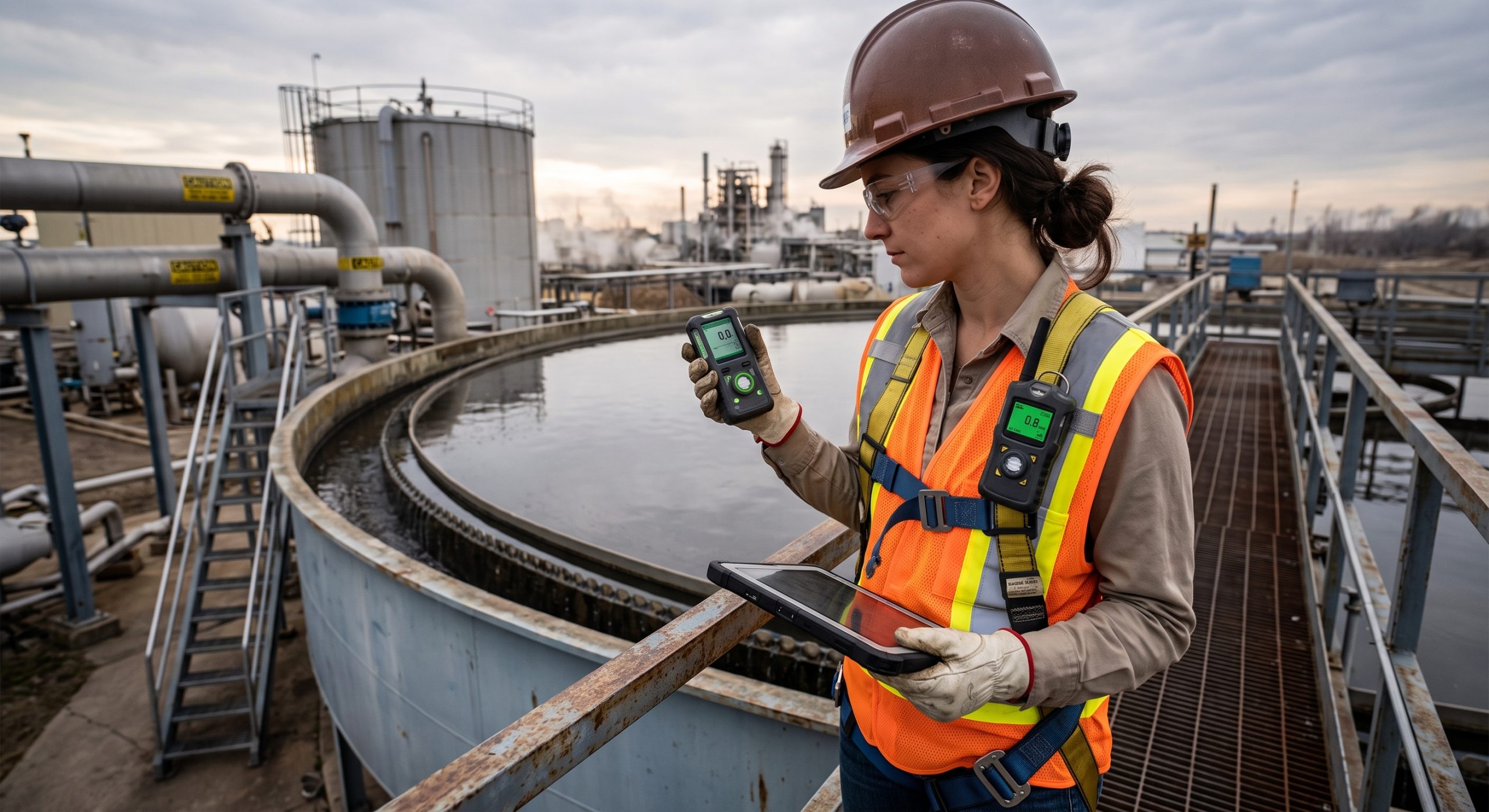
A maintenance programme that calibrates all gas detectors at the same interval, and treats a calibration pass with equal confidence regardless of gas type, may be adequate for oxygen and LEL detectors. It is not adequate for hydrogen sulfide.
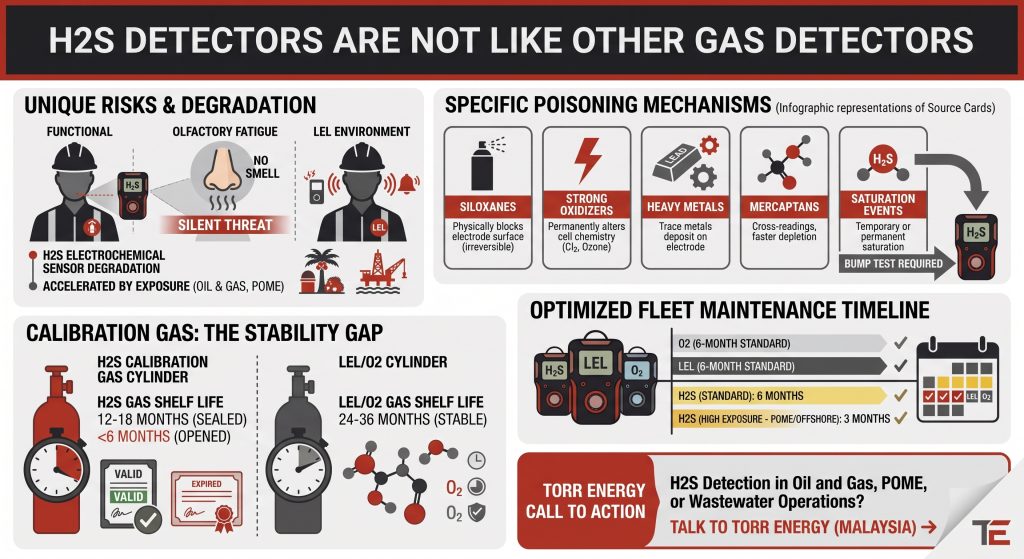
H2S electrochemical sensors degrade through mechanisms that are distinct from LEL catalytic bead or oxygen sensors. They are more easily poisoned by contaminants common in H2S environments. The calibration gas they require has a shorter stable shelf life than calibration gas for most other targets. And the consequences of a poisoned or drifted H2S sensor going undetected are more severe. H2S at concentrations well below IDLH causes olfactory fatigue within minutes, meaning a worker whose detector is under-reading cannot rely on their sense of smell as a backup indicator.
What makes H2S electrochemical sensors degrade faster
The electrochemical cell in an H2S sensor oxidises hydrogen sulfide at the working electrode using an electrolyte. This is a consuming reaction where the chemical reaction that produces the detection signal also gradually depletes the active sensing material.
High H2S exposure accelerates sensor depletion. A sensor deployed in an environment with frequent or elevated H2S events will reach the end of its service life faster than one in a lower-exposure environment. This is directly relevant for offshore oil and gas applications and palm oil mill effluent (POME) pond monitoring in Malaysia.
Sensor poisoning: what damages H2S sensors in the field
Calibration gas for H2S: the shelf life challenge
Most calibration gas mixtures for LEL and O2 calibration are stable for 24 to 36 months from the date of manufacture. H2S calibration gas is significantly less stable. H2S reacts slowly with moisture and with the internal surface of the gas cylinder, causing the certified concentration to decrease over time and be out of balance, particularly after the cylinder has been opened and the pressure has begun to drop.
| Stage | Status | Implication |
|---|---|---|
| Cylinder sealed (0 to 6 months) | Certified | Concentration within certified tolerance. Valid for calibration. |
| Cylinder opened (3 to 6 months post-open) | Verify | Concentration may be drifting. For precision calibration, use fresh cylinder. |
| Beyond expiry or more than 6 months open | Do not use | Calibrating with expired gas produces a certificate that does not reflect true accuracy. Invalid for compliance. |
The gas cylinder expiry date is not a bureaucratic formality for H2S calibration. It is a technical boundary. Using H2S calibration gas beyond its certified date produces a calibration record that satisfies the compliance checkbox but does not guarantee the detector is calibrated to the concentration the certificate states.
Calibration comparison: H2S vs other detector types
| Factor | H2S sensors | LEL (catalytic bead) | Oxygen sensors |
|---|---|---|---|
| Sensor degradation | Chemical depletion; accelerated by high exposure and environmental contaminants | Catalyst surface degradation; accelerated by catalyst poisons | Electrochemical depletion; relatively predictable service life |
| Calibration gas shelf life | Typically 12 to 18 months sealed; limited after opening | 24 to 36 months; more stable | 24 to 36 months; stable |
| Poisoning risk | High. Multiple common industrial substances can permanently damage the electrode | High for silicones and lead | Low. Few common substances permanently damage O2 sensors |
| Recommended calibration frequency | 6-monthly standard; 3-monthly for high-exposure applications (offshore, POME) | 6-monthly standard | 6-monthly standard |
H2S Detection in Oil and Gas, POME, or Wastewater Operations?
Torr Energy provides ISO 17025 calibration services for H2S detectors, including traceable calibration gas with documented shelf life, post-saturation calibration, and fleet calibration programmes.
Talk to Torr Energy →


Leave a Reply